

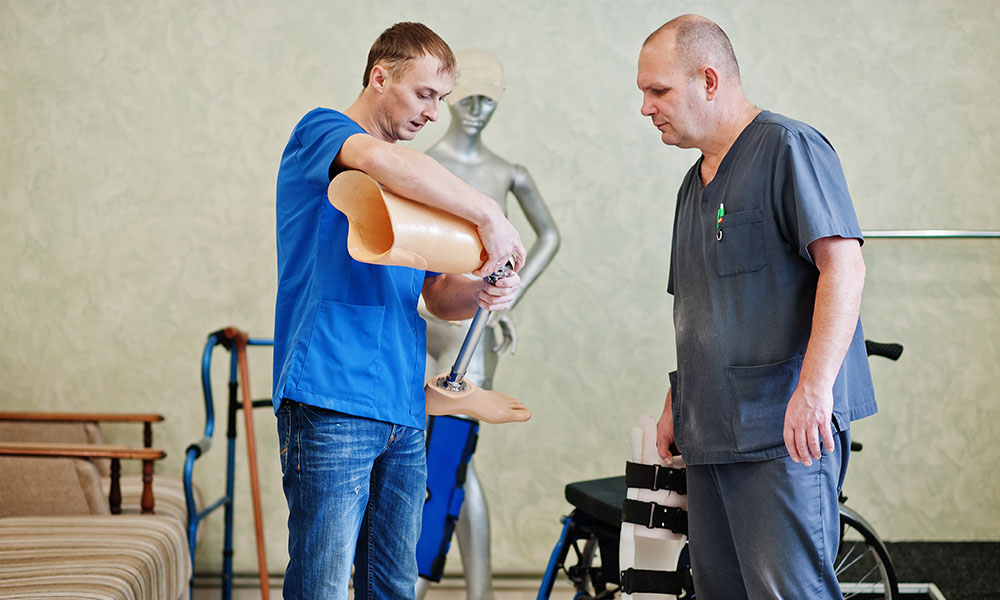
Personal injury claims: The role of an Orthotist and Prosthetist
Injuries as a result of a motor vehicle or other accident, can leave a person with devastating physical and mobility challenges. One of the experts which assists with determining the physical impact of an injury and how a person can be assisted to regain mobility is an Orthotist and Prosthetist.
Usually when one thinks of a prosthesis, it is associated with an amputated leg or arm. The most common way in which a Prosthetist helps an injured person, is by providing a prosthesis in the case of amputated limbs. However, an Orthotist and Prosthetist can assist with other issues, such as shortened or unequal legs, gait correction and assistive devices to help with mobility and pain reduction.
Recovering or stabilising an injury can require a lot of treatment and special devices, which in turn can bring about astronomical medical expenses. Knowing what the impact of your injury will be on your ability to be as mobile and independent as possible, as well as the recommended treatment and the costs related thereto is important in a personal injury claim. These evaluations are done with the help of medico-legal reports provided by specialists in their field of expertise.
What does an Orthotist and Prosthetist do?
Orthotics refer to bracing or splints that provide support or correction of a limb or body part. Prosthetics refer to artificial limbs or devices that replace limbs or other body parts lost as a result of amputation.
In a personal injury matter, an Orthotist and Prosthetist can give opinions and recommendations to the court on the extent of the injury and the coats, treatment, equipment and modifications needed for the duration of the patient’s life.
Qualifications and training needed
In order to qualify as an Orthotist and Prosthetist, either a National Diploma in Medical Orthotics and Prosthetics or a Baccalaureus Technologiae Degree in Medical Orthotics and Prosthetics has to be completed. Thereafter a 12 months internship at a training centred is required before one can register as a medical Orthotist and Prosthetist with the HPCSA (Health Professions Council of South Africa).
Examples of costs that can be claimed in a personal injury case:
- Consultations, assessments, fittings, modifications, surgery, therapy and rehabilitation costs.
- Prosthesis and equipment costs, including prosthetics that have special designs to make them suitable for work, sport or other specific activities.
- Bionic prosthesis can also be considered if the patient’s injury makes it a viable option. Bionic limbs typically work by detecting signals from the user’s muscles. For example, when a person puts on their bionic limb and flexes the muscles above or below the limb, sensors will react to elicit the appropriate movement in the prosthetic hand and fingers. Bionic limbs are often equipped with sensors to detect these muscle movements.
- Walking aids and various supporting equipment like crutches, walking frames, medical stockings, and sports injury aids.
- Insoles to improve your posture, correct your gait, assist with leg, foot, or back injuries and more.
How can attorneys help you?
A patient’s needs can change over the span of their lifetime and ensuring that they have the finances or ability to access the medical care they need related to the injury is important. In Road Accident Fund claims, this can be covered by way of a medical undertaking (in terms of a Section 17(4) undertaking certificate) where the RAF can reimburse future expenses as they are incurred.
In other claims (not against the Road Accident Fund) compensation also has to be claimed on a once-off basis, and including possible future expenses is essential. Claiming compensation for all the unknown future expenses is near impossible without a knowledgeable expert and can leave an injured person seriously undercompensated and unprepared. Click here to view the claims process.
If you need assistance to ensure that a comprehensive claim for compensation is submitted on your behalf, feel free to contact our offices at 012 809 1588 or paul@pauldup.co.za
Written by
Dané du Plooy